
Understanding Web3: GameFi Edition

GameFi is an exciting space in the world of Web3 that has seen continued growth despite recent turbulence in crypto markets. But how do we game the GameFi space? What’s adoption looking like for the industry? How do we build great games? How might we break into the GameFi industry?
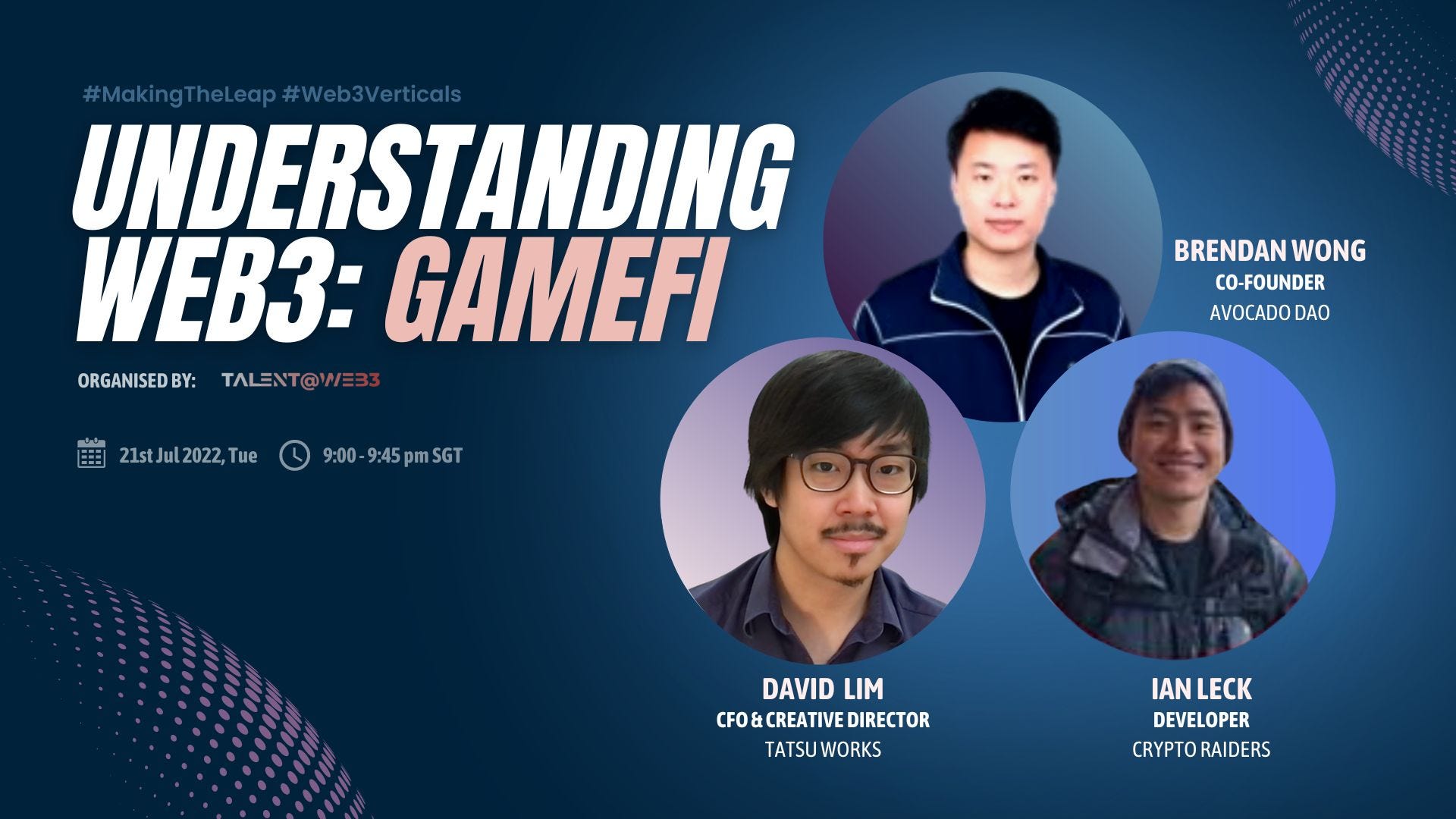
The team at Talent@Web3 picked the brains of industry experts Brendan Wong, Co-Founder at Avocado DAO and David Lim, CEO & Creative Director at Tatsu Works on their thoughts about this rapidly evolving space during an engaging panel discussion moderated by Ian Leck, Developer at Crypto Raiders.
What is the short and long term goal of GameFi and what will it look like to you from the perspective of game creators and players?
David: GameFi is a natural extension of the free to play model. In the traditional free to play model, we rely alot on micro transactions of virtual items to monetise users and maintain the lifespan of your game. However, no one plays a game forever and players want to get as much value as they can for the virtual items they have earned. Since many traditional games did not allow users to sell items, a grey market has always existed — facilitating transactions of virtual items between buyers and sellers for real money. In the short term, Web3 pushes this behaviour into the forefront by putting ownership of virtual items in the hands of players and creating new revenue streams in the process. In the long term, we want to create greater value for players by building an ecosystem where items can be earned and traded among players and infrastructure or marketplace fees earned from those transactions. It allows game creators to continue earning, build better games and create longer lifespans within games.
Interoperability has big potential for GameFi. What kind of trends do you see for the short and long term? Brendan: In the GameFi space, there is true potential for interoperability to take flight. For instance, we could possibly get to a stage where NFTs are interoperable. This means that NFT assets you own do not only operate in the ecosystem in which they were developed. They also
operate in the ecosystem of different companies, different games, different communities and other developed ecosystems. In the short term, we could see the power of NFTs impacting your day-to-day life e.g. access to club events, restaurants etc. In the longer term, true interoperability can be achieved with greater buy-in from larger corporations. To push GameFi to the next level, game developers need to see Web3 as an ingredient in the tool bag — creating a new form of gaming and a space that encourages digital ownership you can take away in the form of NFTs which you can own and have rights to in several ecosystems.
How do you see Gamefi adoption over the next few years?
Brendan: When any new technology is introduced, it takes time to be accepted. If it doesn’t go away, it could be counted as adoption. It’s also when people have reached a stage when they can say they have trust in something. That’s when mainstream adoption happens.
However, trust is not so easily established and that can affect rates of adoption. Although regulation provides that safety net for users, there will always be bad actors who are in it for the wrong reasons in the wild wild west of the Web3 space. However, there are also genuine innovators with ideas they want to try. While they may not always succeed, sometimes they have to fail for adoption to get to where it needs to be. Therefore the way I see it is that gaming has been the catalyst for the adoption of new technology, and how fast GameFi adoption will be over the next few years depends on how much trust the industry can establish with communities.
David: The main obstacle towards adoption is the current GameFi user experience (UX). For instance, people have to install wallets and learn a great deal of things before they can play a Web3 game. As the user experience starts to improve, this will encourage greater adoption. This is one of the main things that needs to be resolved right now and it needs to be seamlessly designed according to how a player would naturally play a game. However, we need to be judicious about the way in which we attempt improve GameFi UX. For instance, it can’t be a careless attempt to sell microtransactions in the guise of NFTs. It’s important that we discover how to use Web3 technologies in a way that truly benefits the user.
How might we build games in the Web3 space?
David: Ownership of virtual items and currencies are now in the hands of Web3 game players. It makes us rethink how we design game economies and gameplay modes, with players now actively participating in the finances of the game. In traditional games, once you purchase an item you can no longer resell the item or currency. However, trading and selling is to be expected in the Web3 space and needs to be a key consideration for builders. Apart from focusing on revenue operations and strong game play in Web2, we need to laser in on live operations and tokenomics when building in Web3. It certainly adds layers of complexity that to date, no one has quite figured out.
Brendan: Like what David said, the key factor introduced into GameFi is the financial element and this significantly increases the difficulty of designing games. More widely when we’re thinking about game design we need to figure out how we can use Web3 technology to build more effectively. For instance, we need to consider the interconnectivity and interoperability of NFT items between games to create more value for communities.
As the saying goes, the bear market is the bull market for builders. How is the current bear market affecting growth, hiring, fundraising and development in the Gamefi industry?
David: Conservation of capital is top priority in a bear market, especially for teams that rely on venture capital (VC) funding to build a product. In a bull market, projects that may not have had a solid foundation could raise capital easily. However in a bear market that changes because the sentiment is very different. There’s possibly not much VC appetite in a bear market and companies may face difficulty raising VC funding now. While there are apparent challenges in a bear market, companies with enough capital can seize opportunities in this situation. Despite not being able to grow their team size, these companies can capture alot of market share as their competitors may not have enough product market fit. From a game development standpoint, it’s important regardless of the type of market we are in to set expectations within the community about the speed of game development as a long and iterative process.
Brendan: There’s generally more noise in a bull market and it’s true that a bear market is the best time for building. Although there are not many competitors in a bear market, sometimes projects may die off due to a lack of funding or perhaps because Web3 was not what they thought it was. Regardless of whether we’re in a bull or bear market, founders still have a crucial role to play to get a project up and running with resilience, mental fortitude and money in the bank. Additionally, founders need to remain cognisant of market peaks and troughs in order to strategically deploy capital and manage what is being built.
What is the role of guilds and how do they support GameFi?
Brendan: The role of guilds has evolved over time but its original function still remains the same. As a guild, we exist to onboard users to the Web3 space using gaming as a catalyst and facilitate knowledge sharing of what an NFT can do e.g. borrowing a digital asset and being able to revenue share and split earnings with lenders. Over time, a guild’s job has evolved to take on the role of educating game developers on the latest trends, given our firsthand exposure to the needs of users on the front end. Therefore, it’s our responsibility to educate game developers on the changing landscape to help them build better.
In the context of guilds, how significantly do Web3 communities influence game development cycles?
Brendan: From a funding perspective, gaming guilds try to raise funds and in turn, we listen to what the investors want. However in the long term, it is the community we have built that plays a significant role in influencing game development cycles. At the heart of Web3 is inclusivity
and fostering a strong community. That’s how innovation is bred and born. It’s important to listen to the community, be there and reassure them that good founders are here to stay. With these inputs from our community, it helps us build better products and in the long run see GameFi evolve into a brand new sector of gaming. On the topic of game development cycles in a Web3 context, what works now may not work in 3–4 months time. Therefore Web3 founders need to pivot faster to stay relevant to their communities.
How did you start out in the world of GameFi?
Brendan: We started Avocado DAO in 2021 and became the largest gaming guild in that very same year. When we first started, this whole concept of a guild was very new and nobody really knew what it was. We had the idea of building guilds in 2005 as a community of people who play games. Since then, it has evolved into fostering a community of gamers who use NFTs as characters and items. Ultimately, we want to build a gaming community who can benefit from Web3 technology and to see where this takes us.
David: In late 2015 when Discord was relatively unknown we started building a gamification platform on the Tatsu Discord server. It grew to become one of the largest Discord communities, attracting the attention of influential YouTubers who started using Discord and Tatsu. Our goal is to bring strong RPG experiences to communities and we’re working on transforming the platform into a cross platform MMORPG where you can play on Discord and mobile.
What do you need to work in the GameFi space?
David: There’s no established rules owing to the fact that GameFi has barely been around for 2–3 years and is still a very nascent industry. Truthfully, a lot of people in this space are still trying to figure out how everything works. Regarding hiring people in the industry, it’s difficult to find someone with the experience required. For example, it’s very hard to find someone with game design experience and economic experience. The positive thing is that Web3 skillsets can be picked up. In fact, half of our team did not have a Web3 background in the past.
Brendan: The people that stay in Web3 are the ones who are inquisitive. So if you want to work in Web3, you’ll thrive if you are inquisitive by nature. The answers are not always there and you’ll need to find them yourself. Moreover, there’s no course out there that can teach you about game development. It’s whether you want to ask the questions and acquire as much knowledge as you can to succeed in this space.
How would people who have built their career in the Web2 space attempt to switch to full time careers in the Web3 GameFi space?
Brendan: Actually there’s many people not just in the e-sports scene but also in the traditional game development scene that have come into Web3 to create their games and support game development. They bring a fresh air of experience and that can be quite helpful.
David: A base level understanding of how crypto markets and NFTs work is quite important, as well as getting familiar with the different communities and how they behave. NFT communities are very different from gaming communities. They are extremely fervent supporters
and are very invested in the particular game they are representing, owing to the fact that they also have a financial interest in the game. This could be something people in the Web2 space might have to get used to.
Ian: Gaming experience does help when going into GameFi and the more experience you have professionally in Web2 gaming the better it would be for your case when you’re transitioning to Web3.
Which Web3 games are you excited about?
David: I’m excited about games like Nyan Heroes and Sipher because for those games it’s a bit hard to build Web3 technologies into. We are an MMORPG and have got a lot of items. In the space, it’s generally accepted that in MMOs you can get ahead by paying a bit of money. People are more open to buying items on marketplaces. But for competitive games like Nyan Heroes, everything has to be fair. You can’t let money get in the way of skill-based game play. So I think them having stuck to their roots as a competitive battle royale that doesn’t allow people to pay for statistics or edge up over other players is quite commendable.” It’s very different from current play-to-earn games out there.
Brendan: At Avocado I’ve spoken extensively to many game developers and for some of them we’ve also invested in as well. I would say we’re quite bullish on the ones we’ve invested in. As the space evolves, adoption becomes more mainstream. This means an increase in regulations and more users understanding Web3 technology and being educated about the risks involved. Only when that happens will we start to see better games being built. At the end of the day, I believe the GameFi industry will allow for the presence of different kinds of games than what we’re seeing in the traditional Web2 space. They may not necessarily be the same in terms of how they would monetise the game, but neither will the experience be completely the same.
Follow us on telegram to stay informed of our latest learning sessions and meetups at https://t.me/talentatweb3